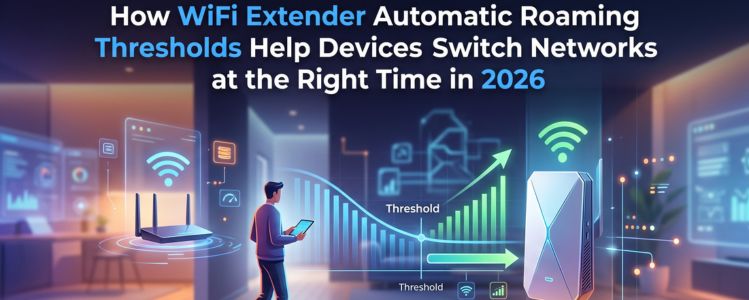
Modern homes increasingly depend on WiFi for everything from video streaming and online gaming to smart home automation, security cameras, and connected appliances. As wireless devices continue to grow in number, maintaining stable connectivity throughout the home has become more important in 2026. A properly configured extender can help improve coverage, while a successful mywifiext setup allows users to establish their extender network more effectively. Users can also access compatible extender settings through mywifiext.local, making it easier to manage wireless configurations and support a smoother whole-home WiFi experience.
What Are WiFi Extender Roaming Thresholds?
WiFi roaming refers to the process through which a wireless device moves from one access point to another while remaining connected to the same broader network environment. In a home using a router and WiFi extender, roaming can allow a smartphone, laptop, or tablet to move between coverage areas without unnecessarily remaining connected to a weak access point.
A roaming threshold represents a condition that can encourage a device to reconsider its current connection. This condition may involve signal strength or other connection-quality factors, depending on the network and client device.
The purpose is simple: help devices switch when the alternative connection is meaningfully better rather than waiting until the existing connection becomes extremely weak.
Why Automatic Roaming Matters in 2026
Homes are becoming more connected than ever. People regularly move between rooms while using smartphones, laptops, tablets, and other wireless devices. Without effective roaming behavior, a device may remain connected to the main router even after moving closer to an extender. This can result in:
- Weak signal strength
- Slower data speeds
- Increased latency
- Unstable connections
- Poor video-call quality
- Interrupted online activities
Automatic roaming can help minimize these problems by allowing compatible devices to reconsider their connection as wireless conditions change.
How Roaming Thresholds Work
A wireless device continuously evaluates aspects of its current connection. When the connection becomes weaker or less suitable, the device may search for another available access point. A simplified roaming process looks like this:
- The device connects to an access point.
- Signal and connection conditions change as the user moves.
- The current connection reaches a roaming-related threshold.
- The device evaluates nearby access points.
- A stronger suitable connection may be selected.
- The device continues communicating through the new access point.
The exact process varies depending on the client device, WiFi standards, router, extender, and network configuration.
Preventing Sticky Client Problems
One of the common challenges in multi-access-point networks is sticky-client behavior. This happens when a device continues using an access point even though another nearby access point may offer a stronger connection.
For example, consider someone starting a video call in a room next to the router and then walking upstairs. The phone may continue using the router’s signal even when the extender upstairs provides better coverage.
If the device and network support appropriate roaming behavior, the client can be encouraged to reassess its connection as signal conditions change. This can improve the overall user experience without requiring manual network selection.
The Importance of WiFi Extender Placement
Automatic roaming cannot compensate for poor extender placement. An extender needs a sufficiently strong connection to the main router while also being close enough to the areas requiring improved coverage.
During mywifiext setup, users should consider the location of:
- The main router
- The WiFi extender
- Frequently used devices
- Thick walls and floors
- Large appliances
- Potential sources of wireless interference
An extender positioned too far from the router may have difficulty providing reliable extended coverage. On the other hand, positioning it too close may limit its ability to improve coverage in weak-signal areas.
How mywifiext.local Helps With Configuration
For compatible Netgear extenders, mywifiext.local can provide access to the extender’s local configuration interface when the user’s device is connected appropriately. Depending on the extender model and firmware, the interface may allow users to review or modify various network settings.
This can be useful when configuring the extender, checking wireless options, and making adjustments to improve coverage. Users should always follow the instructions specific to their extender model because available settings can differ between products.
Why a Proper mywifiext setup Matters
A successful mywifiext setup establishes the basic configuration required for an extender to work with the existing home network.
During setup, users should pay attention to:
- Correct router credentials
- Extender placement
- Network name settings
- Wireless security
- Firmware availability
- Device compatibility
- Coverage requirements
Once setup is complete, users should test connectivity in different parts of the home. Moving around with a smartphone or laptop can help reveal areas where the connection remains weak or where roaming does not occur as expected.
Roaming and Mobile Devices
Smartphones and tablets are among the devices that can benefit from effective roaming because users frequently carry them between rooms. A person might move from:
- The living room to the bedroom
- The ground floor to an upper floor
- A home office to a kitchen
- An indoor area to a garage
As the device changes location, the relative strength of available access points changes as well. Appropriate roaming behavior can help the device select a more suitable connection instead of remaining attached to an increasingly weak signal.
Roaming Can Benefit Remote Work
Reliable WiFi roaming has become particularly important for people working from home. Video meetings, cloud applications, remote desktops, and voice calls can be sensitive to unstable wireless connections.
If a user moves around the house while participating in a meeting, a well-designed WiFi network can help maintain connectivity across different coverage areas. However, roaming does not guarantee uninterrupted service. The device, network equipment, application, and wireless environment all influence the final experience.
Smart Home Devices and Roaming
Modern smart homes may contain dozens of connected devices, including:
- Smart speakers
- Security cameras
- Smart TVs
- Tablets
- Smart appliances
- Home automation controllers
- Wireless sensors
Not all of these devices roam in the same way. Many stationary IoT devices may remain connected to one access point for long periods. For mobile devices, however, effective roaming can make whole-home connectivity much more convenient.
Why Roaming Too Early Can Be a Problem
Switching networks is not always beneficial. If a device moves between access points too aggressively, it may switch even when the existing connection remains perfectly usable. Repeated switching can create instability and unnecessary interruptions.
This is why the timing of a roaming decision matters. An effective roaming strategy aims to find a balance between:
- Connection strength
- Stability
- Performance
- Device mobility
- Access-point availability
The goal is not to make devices switch constantly. Instead, devices should switch when there is a meaningful reason to do so.
How Network Interference Affects Roaming
Wireless interference can complicate roaming decisions. Neighboring WiFi networks, Bluetooth devices, household appliances, walls, and other obstacles can influence wireless performance.
A device may therefore experience changes in connection quality even when it has not moved significantly. Maintaining updated firmware, selecting suitable network settings, and placing the extender appropriately can help reduce some common connectivity issues.
Testing Your Extender Network
After completing mywifiext setup, users should test the network from different locations. A simple test can involve:
- Connecting a smartphone to the WiFi network.
- Starting near the main router.
- Moving gradually toward the extender.
- Checking signal and connection behavior.
- Repeating the test in frequently used areas.
If a device consistently remains connected to a weak access point, users can investigate device-specific roaming behavior and extender configuration.
The Future of Intelligent WiFi Roaming
As wireless networks become more sophisticated, roaming decisions are increasingly focused on overall connection quality rather than signal strength alone.
Future systems may consider factors such as:
- Available bandwidth
- Network congestion
- Latency
- Connection stability
- Device requirements
- Access-point workload
This could make roaming more intelligent and responsive for large homes containing many connected devices.
Final Thoughts
Automatic roaming thresholds can help compatible WiFi devices switch between access points at more appropriate times, reducing the likelihood of remaining connected to a weak signal. For modern homes, this can contribute to a smoother and more reliable wireless experience.
However, successful roaming depends on more than thresholds alone. Extender placement, client-device capabilities, network configuration, interference, and firmware can all influence performance.
By completing a careful mywifiext setup, using mywifiext.local for supported configuration tasks, and testing coverage throughout the home, users can create a stronger foundation for reliable whole-home WiFi in 2026.
FAQs
1. What is a WiFi roaming threshold?
A WiFi roaming threshold is a connection-quality condition that can encourage a compatible wireless device to search for and potentially switch to another access point.
2. Why do devices sometimes stay connected to a weak WiFi signal?
This can happen because the client device controls much of the roaming process. Some devices may be reluctant to switch access points until the current connection becomes sufficiently weak.
3. Can mywifiext.local be used to configure a WiFi extender?
For compatible Netgear extenders, mywifiext.local can provide access to the local extender configuration interface when the device is connected appropriately.
4. Why is mywifiext setup important?
A proper mywifiext setup helps establish the extender’s connection with the existing network and allows users to configure supported wireless settings.
5. Where should I place my WiFi extender?
The extender should generally be placed where it can receive a reliable signal from the main router while extending coverage into the area where better connectivity is needed.
6. Does automatic roaming guarantee a seamless connection?
No. Roaming behavior depends on the client device, router, extender, wireless standards, network configuration, and surrounding interference.