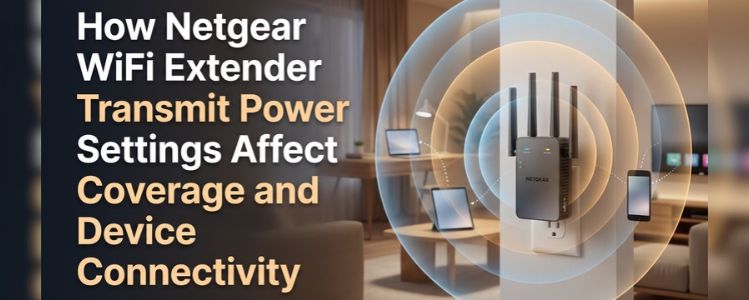
WiFi extenders help expand wireless coverage in areas where a router’s signal becomes weak or unreliable. However, increasing wireless transmit power does not always guarantee better connectivity. The relationship between signal strength, interference, device distance, and network performance determines how effectively an extender serves connected devices. Understanding transmit power settings can help users optimize coverage during Netgear WiFi extender setup and manage configuration options through mywifiext.net.
What Is WiFi Extender Transmit Power?
Transmit power refers to the strength of the wireless radio signal transmitted by a networking device. A WiFi extender receives a signal from the main router and retransmits wireless connectivity to devices within its coverage area.
Depending on the extender model, firmware, and regulatory requirements, some devices provide configurable wireless power settings. Others automatically manage transmission power without offering a manual adjustment.
Transmit power can influence how far a signal travels, but it is only one factor affecting wireless performance. Antenna design, frequency band, physical obstacles, interference, and receiver sensitivity also play important roles.
How Transmit Power Affects WiFi Coverage
Wireless signal strength generally decreases as distance from the transmitting device increases. Walls, floors, furniture, and other obstacles can further reduce signal quality. Adjusting transmit power, where supported, can influence the coverage area in several ways.
1. Increasing Coverage in Weak-Signal Areas
A higher transmit power setting may help an extender deliver a stronger signal to devices located farther away. This can be useful in certain layouts where the extender has sufficient backhaul connectivity and connected devices are positioned near the edge of its coverage area. However, stronger transmission does not overcome every physical obstacle or guarantee higher internet speeds.
2. Reducing Unnecessary Signal Overlap
When an extender and router transmit at high power, their coverage areas may overlap extensively. In some environments, excessive overlap can contribute to interference or make roaming decisions less predictable for certain devices. A suitable power level can help maintain balanced coverage between the router and extender.
3. Maintaining Connectivity Across Multiple Rooms
Multi-room homes often contain walls and other materials that weaken wireless signals. An extender can help improve connectivity in these areas when placed correctly. Transmit power may influence the signal delivered to distant devices, but extender placement and the quality of the connection to the main router remain equally important.
Why Higher Transmit Power Does Not Always Improve Performance
Increasing transmit power may appear to be an easy solution for weak WiFi, but it does not necessarily improve two-way communication.
A WiFi connection requires both the extender and the connected device to transmit and receive signals. Even if an extender sends a stronger signal, a smartphone or laptop may not have enough transmission power to communicate reliably in return.
Other potential problems include:
- Greater interference with nearby wireless networks.
- Increased overlap between router and extender coverage.
- Unbalanced signal strength between devices.
- Persistent dead zones caused by physical obstructions.
- Reduced performance when the extender has a weak connection to the main router.
For this reason, users should evaluate overall connection quality rather than relying only on the displayed signal bars.
Choosing the Right Extender Placement
Placement is one of the most important parts of Netgear WiFi extender setup. An extender should generally be positioned where it can receive a reasonably strong signal from the main router while still providing coverage to the area that needs improvement.
Consider these placement recommendations:
- Position the extender away from thick walls and large metal objects.
- Avoid placing it directly beside appliances that may cause interference.
- Maintain a suitable distance from the router rather than placing it at the far end of a dead zone.
- Test connectivity in the rooms where devices are regularly used.
- Adjust the location if the extender reports a weak connection to the router.
A well-positioned extender with balanced transmit power may perform better than a poorly positioned device operating at maximum power.
How to Review WiFi Settings Through mywifiext.net
The local administration interface provides access to supported extender configuration options. During setup, users may access mywifiext.net while connected to the extender’s network. The exact settings and available menus depend on the model and firmware version.
General configuration steps include:
- Connect a computer or mobile device to the extender’s WiFi network.
- Open a compatible web browser.
- Enter mywifiext.net in the address bar.
- Sign in using the extender’s administrator credentials.
- Open the wireless or advanced settings section, if available.
- Review supported radio and transmit power options.
- Save changes and reconnect devices if necessary.
Not every NETGEAR extender provides manual transmit power controls. Users should avoid changing unrelated wireless settings simply to increase coverage.
Common Connectivity Problems Related to Coverage Settings
- Devices Show Strong WiFi but Internet Access Is Unavailable: This may indicate a weak router-to-extender connection, an internet service problem, or incorrect network configuration. Check the extender’s connection to the main router before changing transmit power.
- Devices Frequently Disconnect: Frequent disconnections may result from interference, outdated firmware, poor placement, or device-specific wireless compatibility problems.
- WiFi Coverage Is Uneven: Move the extender to a more suitable location and test coverage in different rooms. Increasing transmit power alone may not resolve uneven coverage.
- Some Devices Prefer the Main Router: Client devices usually make their own roaming decisions. A device may remain connected to the main router even when the extender is closer. This behavior does not necessarily indicate a faulty extender.
Best Practices for Reliable Netgear WiFi Extender Performance
For consistent results, keep extender firmware updated, use compatible wireless settings, and avoid unnecessary changes to advanced configuration options.
During Netgear WiFi extender setup, test both the extender’s connection to the router and the connection from the extender to client devices. Use mywifiext.net to review model-supported settings and check whether the device requires repositioning.
Final Thoughts
Transmit power settings can influence WiFi extender coverage and device connectivity, but maximum power is not always the best solution. Balanced signal strength, proper placement, reliable backhaul connectivity, and reduced interference are all important for stable wireless performance.
By reviewing supported settings through mywifiext.net and following the correct Netgear WiFi extender setup process, users can improve coverage and create a more dependable home WiFi experience.
Frequently Asked Questions
1. What does WiFi extender transmit power control?
It controls the strength of the wireless signal transmitted by the extender, where manual adjustment is supported.
2. Does higher transmit power always improve WiFi speed?
No. Speed also depends on backhaul quality, interference, device capabilities, bandwidth, and router performance.
3. Can I change transmit power through mywifiext.net?
Some models provide wireless power settings through the administration interface, while others manage power automatically.
4. Where should I place a Netgear WiFi extender?
Place it between the router and the weak-signal area, where it can still receive a reliable connection from the main router.
5. Why do devices disconnect even when the WiFi signal is strong?
Possible causes include interference, weak backhaul connectivity, device roaming behavior, firmware issues, or internet service interruptions.