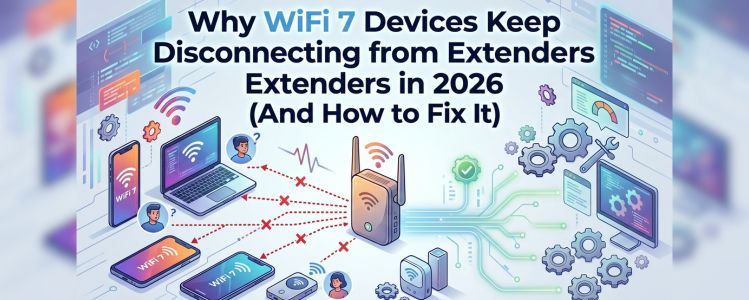
WiFi 7 technology is transforming home networking in 2026 by delivering faster speeds, lower latency, and better multi-device performance than ever before. However, many users are now facing a frustrating issue where WiFi 7 devices repeatedly disconnect from wireless extenders even though the extender appears properly connected.
This problem commonly affects:
- Smartphones
- Gaming consoles
- Smart TVs
- VR headsets
- Laptops
- Smart home systems
Users often notice:
- Random disconnects
- Slow reconnections
- Lag spikes
- Buffering issues
- Weak signal warnings
- Devices switching networks constantly
In many cases, the issue is not internet speed itself but compatibility conflicts, roaming instability, outdated firmware, improper placement, or incorrect Netgear Extender Setup configurations. Problems may also appear when using the extender management portal through mywifiext.local.
This guide explains why WiFi 7 devices disconnect from extenders more frequently in 2026 and how to restore stable wireless performance.
Why WiFi 7 Devices Behave Differently
WiFi 7 devices are designed for:
- Faster roaming
- Lower latency
- Multi-Link Operation (MLO)
- Intelligent band switching
- Advanced traffic balancing
These devices constantly search for the strongest and fastest connection available.
While this improves speed, it also makes WiFi 7 devices more sensitive to weak extender configurations and unstable signal transitions.
Why Extenders Struggle More in 2026
Modern home networks are far more demanding today.
Many households now contain:
- 4K and 8K streaming devices
- Cloud gaming systems
- AI assistants
- Smart security cameras
- IoT devices
- WiFi 7 smartphones and laptops
Older extenders often struggle to manage the increasing number of high-performance connections.
Common Symptoms of WiFi 7 Disconnect Problems
Users frequently report:
- Devices randomly dropping WiFi
- Gaming lag spikes
- Video buffering
- Smart home instability
- Slow reconnect times
- Devices refusing to stay connected to the extender
These symptoms usually indicate extender communication or roaming problems.
Fix #1: Improve Extender Placement
Poor placement remains the most common cause of disconnects.
Best Placement Tips
Position the extender:
- Halfway between router and weak zone
- In open elevated areas
- Away from thick walls
- Away from metal surfaces
Avoid Placement Near
- Microwaves
- TVs
- Large appliances
- Concrete walls
- Bluetooth-heavy devices
Weak signal quality causes WiFi 7 devices to disconnect more aggressively.
Fix #2: Recheck Netgear Extender Setup
Improper Netgear Extender Setup can create:
- Roaming conflicts
- Weak backhaul communication
- Frequency instability
- Device authentication issues
Review your extender settings carefully to ensure:
- Firmware is updated
- SSIDs are configured correctly
- Security settings match the router
- Band steering is functioning properly
A proper setup greatly improves stability.
Fix #3: Access Settings Through mywifiext.local
Open: mywifiext.local
Inside the dashboard:
- Verify extender connection quality
- Check firmware version
- Monitor connected devices
- Review signal strength
- Confirm network synchronization
The management portal helps identify stability problems quickly.
Fix #4: Separate WiFi Bands Temporarily
Many extenders combine:
- 2.4GHz
- 5GHz
- 6GHz bands
into a single network name.
WiFi 7 devices sometimes switch bands too aggressively.
Symptoms Include
- Frequent disconnects
- Devices bouncing between bands
- Sudden speed drops
Temporarily separating bands may improve stability significantly.
Fix #5: Update Extender Firmware
Firmware updates improve:
- WiFi 7 compatibility
- Roaming intelligence
- Device communication
- Network stability
Outdated firmware often causes:
- Authentication failures
- Signal drops
- Device disconnect loops
Always keep both:
- Router firmware
- Extender firmware
fully updated.
Fix #6: Reduce Roaming Aggressiveness
WiFi 7 devices roam faster than older devices.
Some devices disconnect because they constantly search for:
- Stronger signals
- Faster bands
- Lower latency connections
Advanced users may improve stability by adjusting:
- Roaming sensitivity
- WiFi assistant settings
- Smart switching features
within device WiFi options.
Fix #7: Reduce Network Congestion
Heavy traffic can overwhelm extenders quickly.
Common Congestion Sources
- 8K streaming
- Cloud backups
- Online gaming
- Video conferencing
- Large downloads
Reducing simultaneous high-bandwidth activity improves extender performance dramatically.
Fix #8: Disable Legacy Compatibility Features
Older compatibility settings may interfere with WiFi 7 optimization.
Possible settings to disable include:
- Legacy 802.11b support
- Older WPA modes
- Outdated roaming protocols
Modern WiFi 7 devices perform better on optimized modern security settings.
Fix #9: Restart the Entire Network
Temporary memory conflicts are extremely common.
Recommended Restart Order
- Turn off modem
- Router turn off
- Turn off extender
- Wait 2 minutes
- Restart modem
- Router restart
- Restart extender
This refreshes:
- DHCP assignments
- Wireless synchronization
- Routing tables
and often resolves disconnect problems immediately.
Why WiFi 7 Makes Weak Networks More Noticeable
WiFi 7 introduces:
- Faster roaming decisions
- Lower latency expectations
- Intelligent traffic optimization
- Multi-Link communication
These improvements expose weak extender setups much faster than older WiFi generations.
Small network flaws now become highly noticeable.
Why Smart Home Devices Disconnect Frequently
IoT devices often use:
- Low-power WiFi chips
- Older wireless standards
- Limited roaming intelligence
This makes them more vulnerable to:
- Signal instability
- Extender switching
- Authentication conflicts
Stable signal quality matters more than raw speed for smart devices.
Mesh Systems vs Traditional Extenders
Traditional extenders sometimes struggle with:
- WiFi 7 roaming
- Signal overlap
- Device switching
Modern mesh systems offer:
- Better roaming intelligence
- Unified network management
- Stronger backhaul communication
- Improved device prioritization
Large homes may benefit from upgrading to mesh networking systems.
Common User Mistakes
Avoid these setup problems:
- Extender too far from router
- Ignoring firmware updates
- Overloading extender capacity
- Using outdated extenders
- Mixing incompatible security settings
These issues commonly trigger WiFi instability.
Why AI Networking Is Becoming Important
Newer networking systems now use AI-powered optimization to:
- Detect congestion
- Balance traffic automatically
- Optimize channels
- Improve roaming decisions
AI-assisted networking is helping reduce WiFi 7 instability in modern homes.
Signs It May Be Time to Upgrade Hardware
Consider upgrading if:
- Disconnects happen daily
- Extender overheats frequently
- Firmware support has ended
- Devices constantly reconnect
- Coverage remains inconsistent
Older extenders may not fully support advanced WiFi 7 features.
Final Thoughts
If WiFi 7 devices keep disconnecting from your extender in 2026, the issue is usually related to roaming conflicts, outdated firmware, poor placement, network congestion, or improper Netgear Extender Setup configurations.
By optimizing settings through mywifiext.local, updating firmware, separating WiFi bands, improving extender placement, and reducing network congestion, users can dramatically improve WiFi stability and eliminate frustrating disconnect problems.
As modern homes rely more heavily on gaming, streaming, AI systems, and smart devices, properly optimized WiFi extenders are becoming increasingly important for maintaining fast and reliable wireless performance throughout 2026.