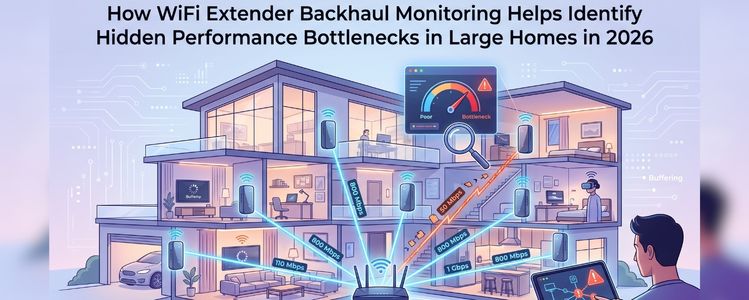
Large homes often require WiFi extenders to improve wireless coverage across bedrooms, upper floors, garages, home offices, and other areas where the primary router signal may become weak. However, simply adding an extender does not always guarantee faster or more reliable connectivity.
One of the less visible factors affecting extender performance is the backhaul connection. The backhaul is the communication link between the extender and the primary router. If this connection is weak, congested, or unstable, devices connected to the extender may experience slower speeds even when the local signal appears strong.
In 2026, backhaul monitoring technology is helping homeowners identify these hidden bottlenecks. During a proper Netgear Wifi Extender Setup, users can pay attention to extender placement, connection quality, and network conditions to improve whole-home performance. The address 192.168.1.250 may also be used by certain extender configurations as a local access address for reaching an extender’s management interface.
What Is WiFi Extender Backhaul?
Backhaul refers to the connection used by a WiFi extender to communicate with the primary router. In a wireless extender configuration, the communication path can be simplified as:
Router → Extender → Connected Device
The extender receives data from the router and then retransmits it to connected clients. This means the quality of the router-to-extender connection can directly affect the performance experienced by devices connected to the extender.
Why Backhaul Performance Matters
A strong connection between a device and an extender does not necessarily mean the extender has a strong connection to the router.
For example, a laptop may show excellent signal strength when connected to the extender, while the extender itself has a weak backhaul connection.
This can result in:
- Lower throughput
- Higher latency
- Buffering
- Connection drops
- Slower downloads
- Reduced responsiveness
Backhaul monitoring helps reveal this hidden performance problem.
What Is Backhaul Monitoring?
Backhaul monitoring involves observing the quality and behavior of the connection between the extender and the main router.
Depending on the device and management system, users may be able to review information related to:
- Connection quality
- Signal strength
- Link speed
- Wireless band
- Connection stability
- Network traffic
These details can help determine whether the extender itself or the backhaul connection is creating a bottleneck.
Hidden Bottlenecks in Large Homes
Large homes can create several networking challenges. Common factors include:
- Thick walls
- Multiple floors
- Concrete structures
- Metal appliances
- Long distances
- Furniture
- Wireless interference
- Neighboring networks
An extender positioned too far from the router may still provide coverage to nearby devices, but its connection back to the router may be weak.
This is one of the most common reasons that adding an extender does not produce the expected performance improvement.
Extender Placement Is Critical
Placement has a major impact on backhaul performance. An extender should generally be positioned where it can receive a reasonably strong signal from the main router while still reaching the area requiring additional coverage.
Placing an extender at the very edge of the router’s coverage area may result in a weak backhaul.
Instead of focusing only on where coverage is missing, homeowners should also consider where the extender can maintain a reliable connection to the router.
How Backhaul Monitoring Identifies Performance Problems
Monitoring can help distinguish between different types of network problems.
For example:
- Strong client connection + weak backhaul: The extender may be positioned too far from the router.
- Weak client connection + strong backhaul: The extender may not be optimally positioned for the client device.
- Strong connections + low internet speed: The problem may originate from the internet service or another part of the network.
This type of analysis makes troubleshooting more systematic.
Wireless Backhaul vs Ethernet Backhaul
Some modern networking environments support wired Ethernet backhaul.
With Ethernet backhaul, the extender or access point communicates with the primary router through a physical network cable.
Potential benefits include:
- More consistent performance
- Reduced wireless interference
- Lower wireless backhaul congestion
- Improved stability
However, Ethernet backhaul requires suitable cabling and compatible hardware.
Wireless backhaul remains convenient for homes where running Ethernet cables is impractical.
Role of Netgear Wifi Extender Setup
A correct Netgear Wifi Extender Setup can help establish a reliable connection between the primary router and extender.
During setup, users should consider:
- Extender placement
- Router proximity
- WiFi band selection
- Network name
- Security configuration
- Firmware updates
- Connected-device requirements
Following the manufacturer’s instructions for the specific model is important because available features and management methods can vary.
Accessing the Extender Management Interface
Certain Netgear extender configurations may use a local IP address such as 192.168.1.250 to provide access to the extender’s management interface.
The exact address depends on the device and network configuration.
If 192.168.1.250 is supported by the particular extender, entering the address into a browser while connected to the appropriate network may provide access to management settings.
Users should always verify the correct access method for their specific extender model rather than assuming the same address applies to every device.
Firmware and Backhaul Performance
Firmware can influence how networking hardware manages wireless connections. Manufacturers may release firmware updates that improve:
- Stability
- Compatibility
- Security
- Performance
- Device management
Keeping supported firmware current can therefore be an important part of maintaining a reliable extender network.
Interference and Backhaul Bottlenecks
Wireless interference can significantly affect backhaul performance.
Potential sources include:
- Neighboring WiFi networks
- Bluetooth devices
- Wireless cameras
- Microwave ovens
- Other wireless electronics
Changing the extender’s location or using a less congested wireless band may improve connection quality.
Monitoring During High Network Usage
Backhaul problems may become more noticeable when multiple devices are active.
For example, a large household may simultaneously use:
- 4K streaming
- Video conferencing
- Online gaming
- Cloud backups
- Security cameras
- Smart home devices
Monitoring the network during these periods can help identify whether congestion is occurring on the backhaul.
Improving Whole-Home WiFi Performance
Once a bottleneck is identified, homeowners can consider several solutions. These may include:
- Moving the extender closer to the router
- Changing the wireless band
- Reducing interference
- Updating firmware
- Using Ethernet backhaul
- Reconfiguring network settings
- Adding appropriately positioned networking equipment
The best solution depends on the home’s layout and network requirements.
Future of Backhaul Monitoring
WiFi management is becoming increasingly automated.
Future systems may use:
- AI-powered diagnostics
- Automatic backhaul selection
- Real-time interference analysis
- Predictive congestion detection
- Dynamic channel selection
- Automatic extender placement recommendations
These technologies could make whole-home network optimization easier for everyday users.
Final Thoughts
WiFi extender backhaul monitoring is becoming an important tool for identifying hidden performance bottlenecks in large homes in 2026. A strong signal between a device and an extender does not guarantee that the extender has a strong connection to the primary router.
By monitoring backhaul quality, homeowners can better understand whether slow speeds, buffering, or connection instability are caused by extender placement, wireless interference, congestion, or another part of the network.
A carefully completed Netgear Wifi Extender Setup can provide a strong foundation for reliable coverage. For supported configurations, 192.168.1.250 may provide a local management path for accessing extender settings, although users should confirm the correct address for their specific model.
Ultimately, reliable whole-home WiFi depends on more than signal strength. Proper placement, compatible hardware, updated firmware, efficient backhaul connections, and regular network monitoring can help large homes achieve more consistent wireless performance.
Frequently Asked Questions
1. What is WiFi extender backhaul?
Backhaul is the connection between a WiFi extender and the primary router. Its quality can significantly affect the speed and stability of devices connected through the extender.
2. Why can an extender show a strong signal but still provide slow speeds?
The device may have a strong connection to the extender while the extender has a weak or congested connection to the router. This creates a backhaul bottleneck.
3. How does Netgear Wifi Extender Setup affect backhaul performance?
A proper Netgear Wifi Extender Setup includes selecting an appropriate location and configuring the extender so it can maintain a reliable connection with the primary router.
4. What is 192.168.1.250 used for?
192.168.1.250 is a local IP address that may be used by certain Netgear extender configurations for accessing the device’s management interface. Availability depends on the specific model and network setup.
5. Can Ethernet backhaul improve extender performance?
Yes. When supported, Ethernet backhaul can provide a more consistent connection between networking devices and reduce dependence on wireless backhaul.
6. Does moving an extender closer to the router always improve coverage?
Not necessarily. Moving it closer can strengthen the backhaul, but the extender must still be positioned effectively to cover the intended area. Finding a balance between router connection and client coverage is important.