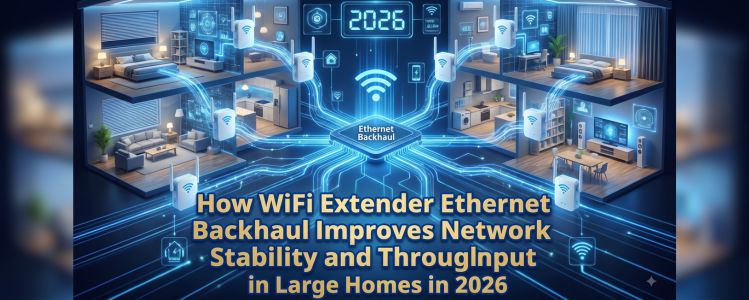
Large homes often experience WiFi challenges because wireless signals must travel through walls, floors, furniture, and other obstacles. A WiFi extender can expand coverage, but wireless communication between the router and extender can still be affected by interference and signal loss. Ethernet backhaul provides an alternative by using a wired connection between compatible networking devices, helping improve network stability and available throughput. During configuration, users may access supported extender settings through mywifiext.local, while 192.168.1.250 may be used as a local management address on compatible Netgear extender configurations.
What Is Ethernet Backhaul?
Ethernet backhaul refers to using an Ethernet cable to connect a WiFi extender or mesh node to the main router instead of relying entirely on a wireless connection between the two devices. In a traditional wireless extender configuration, the extender receives WiFi from the router and then retransmits it to connected devices.
With Ethernet backhaul, the communication between the router and extender travels through a wired network connection. This can reduce the amount of wireless bandwidth required for communication between networking devices.
Why Large Homes Need Better Backhaul
Large homes can contain multiple floors, thick walls, long hallways, and rooms located far away from the main router. These physical conditions can weaken wireless signals.
Common problems include:
- Weak WiFi signals
- Slow speeds in distant rooms
- Connection drops
- Higher latency
- Inconsistent performance
- Reduced throughput
A wired backhaul can help overcome some of these challenges by providing a dedicated physical connection between compatible networking equipment.
How Ethernet Backhaul Improves Stability
Wireless backhaul is vulnerable to radio interference and obstacles between the router and extender. Nearby networks, household electronics, walls, and distance can all affect wireless communication.
Ethernet connections are much less affected by these wireless conditions. As a result, Ethernet backhaul can provide a more consistent connection between the router and extender, particularly in homes where wireless signals struggle to travel between floors or through dense construction materials.
How Ethernet Backhaul Can Improve Throughput
Wireless extenders often use part of their wireless capacity to communicate with the main router. This can limit the bandwidth available to devices connected through the extender.
When the router and extender communicate over Ethernet, that backhaul traffic moves through the wired connection instead. This can leave more wireless capacity available for connected devices. The actual improvement depends on the extender, router, Ethernet speed, WiFi generation, internet connection, and network configuration.
Ethernet Backhaul vs Wireless Backhaul
Both approaches have advantages.
Wireless Backhaul
Wireless backhaul is convenient because it does not require Ethernet cabling. It can be useful when running cables between rooms is difficult.
However, performance can be affected by:
- Distance
- Signal strength
- Interference
- Building materials
- Wireless congestion
Ethernet Backhaul
Ethernet backhaul generally provides a more stable connection between compatible devices. It can be particularly beneficial for:
- Multi-story homes
- Large properties
- Homes with thick walls
- Streaming households
- Gaming environments
- Work-from-home setups
The main requirement is an appropriate wired Ethernet connection between networking devices.
Accessing Extender Settings Through mywifiext.local
Users configuring a compatible Netgear WiFi extender may access its administration interface through mywifiext.local. The interface can provide access to supported configuration and management options, depending on the extender model.
Users may be able to review:
- Network information
- Connected devices
- Wireless settings
- Firmware information
- Security options
- Connection status
The available settings can vary between extender models and firmware versions.
The Role of 192.168.1.250
Some Netgear extender configurations use 192.168.1.250 as a local address for accessing the extender’s setup or administration interface. However, the exact address available to a device can depend on its configuration and network environment.
If 192.168.1.250 does not open the expected page, users should verify that their device is connected to the extender’s network and follow the setup instructions applicable to their specific model.
Best Placement for Ethernet-Connected Extenders
Ethernet backhaul provides a wired connection, but extender placement still matters for delivering WiFi coverage throughout the home. A useful strategy is to place the extender in an area where it can provide strong coverage to nearby rooms and devices.
For example, an Ethernet-connected extender can be positioned:
- On another floor
- Near a home office
- Close to a distant bedroom
- Near a gaming area
- In a large living space
Because the backhaul is wired, the extender does not need to depend on a strong wireless signal from the main router for its connection.
Benefits for Streaming and Gaming
High-bandwidth activities such as 4K streaming, cloud gaming, video conferencing, and large downloads can place significant demands on a network. A stable backhaul can help reduce bottlenecks between the router and extender.
For gaming, Ethernet backhaul may also help create a more consistent connection between the extender and main network, although internet latency still depends on factors outside the local WiFi network.
Ethernet Backhaul for Work-From-Home Networks
Remote workers increasingly rely on stable connections for video meetings, cloud applications, file transfers, and collaboration tools.
An extender with Ethernet backhaul can provide more reliable WiFi coverage in a home office located far from the main router. This can reduce the need to place the primary router in an inconvenient location simply to achieve better coverage.
Tips for Better Extender Performance in 2026
Users can improve their network by following several practices:
- Use high-quality Ethernet cables where appropriate.
- Confirm that the router and extender support the desired backhaul configuration.
- Keep extender firmware updated.
- Position the extender strategically for local WiFi coverage.
- Avoid unnecessary wireless interference.
- Monitor connected devices and network usage.
- Use the appropriate administration interface for the extender model.
- Check network settings if the extender does not appear online.
When supported, using Ethernet for backhaul can be one of the most effective ways to improve network consistency in large homes.
Why Ethernet Backhaul Matters in 2026
As homes continue adding smart TVs, laptops, gaming systems, cameras, smartphones, smart appliances, and other connected devices, reliable network infrastructure is becoming increasingly important.
Wireless technology continues to improve, but physical obstacles and radio interference remain challenges. Ethernet backhaul provides a practical way to combine the convenience of extended WiFi coverage with the stability of a wired connection.
Final Thoughts
WiFi extender Ethernet backhaul can significantly improve network stability and help maintain better throughput in large homes. By transferring communication between the router and extender over Ethernet instead of relying entirely on wireless backhaul, compatible systems can reduce wireless congestion and provide a more consistent connection.
During configuration, mywifiext.local can provide access to supported extender settings, while 192.168.1.250 may serve as a local administration address on compatible configurations. Choosing the right extender, using suitable Ethernet connectivity, maintaining updated firmware, and positioning the equipment properly can help create a stronger and more reliable home network in 2026.
FAQs
1. What is Ethernet backhaul on a WiFi extender?
Ethernet backhaul uses a wired Ethernet connection between the main router and a compatible extender instead of using WiFi for that connection.
2. Does Ethernet backhaul improve WiFi speed?
It can improve available wireless throughput by moving router-to-extender traffic onto a wired connection. Actual performance depends on the networking equipment and configuration.
3. What is mywifiext.local used for?
mywifiext.local can be used to access the administration or setup interface of supported Netgear WiFi extenders.
4. What is 192.168.1.250 used for?
192.168.1.250 is associated with the local setup or management interface of some Netgear extender configurations. The exact address depends on the device and network setup.
5. Is Ethernet backhaul useful for large homes?
Yes. It can be particularly useful in large or multi-story homes where wireless backhaul is affected by distance, walls, floors, or interference.