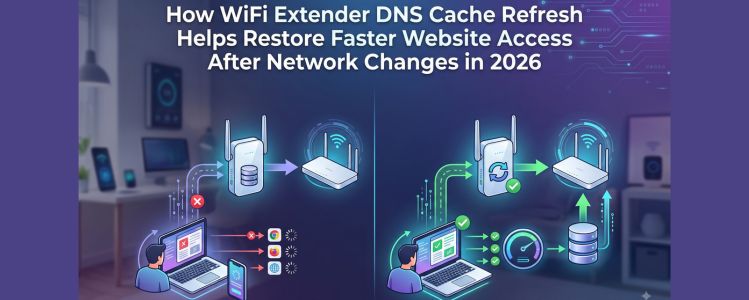
Modern home networks frequently undergo changes such as router replacements, DNS configuration updates, firmware upgrades, ISP changes, and network reconfiguration. After these changes, some websites may load slowly, fail to open, or continue resolving through outdated DNS information. During troubleshooting, users may access mywifiext.local to manage supported WiFi extender settings, while 192.168.1.250 may be used by certain extender models as a local management address. Understanding DNS caching and cache refresh procedures can help users restore normal website access more efficiently in 2026.
What Is DNS Cache?
The Domain Name System (DNS) translates human-readable website names into IP addresses that network devices can use to establish connections. For example, when a user enters a website address, a DNS resolver helps determine the corresponding IP address.
To avoid repeatedly requesting the same information, networking devices and operating systems may temporarily store DNS results in a cache. This can improve browsing efficiency, but cached information can become outdated after network changes.
Why DNS Cache Can Affect Website Access
DNS records can change for many reasons. A website may move to a new server, change its hosting infrastructure, update its IP address, or modify its DNS configuration. If a device or network component continues using an older cached DNS result, the user may experience:
- Website loading delays
- Incorrect website destinations
- Intermittent access
- DNS-related errors
- Pages that fail to load
- Different behavior between devices
Refreshing the relevant cache can help the network obtain current DNS information.
How WiFi Extenders Interact With DNS
A WiFi extender primarily expands wireless coverage, but its network behavior depends on its operating mode and configuration. Depending on the model, an extender may participate in network communication between wireless clients and the primary router. DNS requests may ultimately be handled by the router, ISP, or another configured DNS resolver.
Because network architecture varies, DNS caching behavior is not identical across all extenders. Users should therefore identify whether the DNS issue originates from:
- The client device
- The WiFi extender
- The primary router
- The configured DNS resolver
- The ISP
This distinction is important before changing network settings.
Why Network Changes Can Create DNS Problems
Several common network changes can trigger DNS-related connectivity issues.
- Router Replacement: Installing a new router can introduce different DHCP and DNS configurations.
- ISP Changes: A new internet provider may use different DNS infrastructure.
- DNS Server Changes: Users may manually configure alternative DNS services on compatible routers or devices.
- Firmware Updates: Router or extender firmware updates can change network behavior or reset certain settings.
- Network Reconfiguration: Changing access point modes, IP settings, or DHCP configuration can affect how DNS requests are handled.
After these changes, cached information may not immediately reflect the new network environment.
Accessing Extender Management Settings
When troubleshooting a compatible extender, users may access its local management interface through mywifiext.local. This address is intended for local network management rather than general internet browsing. Availability and access procedures depend on the extender model and network configuration.
Some extender models may instead use a local IP address such as 192.168.1.250 for management.
Users should check their specific device documentation because management addresses can vary between models and configurations.
Refreshing DNS Information on the Client Device
In many situations, the DNS cache that needs refreshing is actually stored on the computer or mobile device rather than the extender. Operating systems maintain DNS information to improve lookup performance.
If a website continues resolving incorrectly after a network change, restarting the device or refreshing its DNS cache can help it request current DNS information. The exact cache-clearing procedure depends on the operating system.
Users should avoid changing advanced DNS settings unnecessarily if basic troubleshooting resolves the problem.
Checking Router and Extender Configuration
If refreshing the client DNS cache does not solve the problem, inspect the network configuration. Check whether:
- The extender is connected to the primary router.
- The client has a valid IP address.
- The default gateway is correct.
- DNS servers are reachable.
- The extender is operating in the intended mode.
- DHCP is being handled by the appropriate network device.
A misconfigured DHCP or gateway setting can cause problems that appear to be DNS-related.
Signs That DNS May Be the Problem
DNS may be worth investigating when:
- Some websites work while others do not.
- A website opens using an IP address but not its domain name.
- Different devices experience different website behavior.
- A recently changed domain appears unavailable.
- Restarting the network temporarily resolves the issue.
These symptoms do not prove that DNS is the cause, but they can provide useful troubleshooting clues.
How 192.168.1.250 Fits Into Troubleshooting
For compatible WiFi extenders, 192.168.1.250 can provide access to the local extender management interface. It should not be confused with a public internet address or a DNS server.
If the extender’s management page cannot be reached, users should first verify that their device is connected to the extender’s network and that the extender actually uses this address. Network changes can alter local addressing, so the management address may not always be reachable in every configuration.
Best Practices After Network Changes
After replacing or reconfiguring network equipment, users can follow several practical steps:
- Restart the router and extender.
- Confirm that the extender is connected correctly.
- Check the client device’s IP configuration.
- Refresh the device’s DNS cache when appropriate.
- Verify DNS server settings.
- Test multiple websites.
- Check whether the issue affects one device or the entire network.
- Access the extender’s management interface when necessary.
- Update firmware if an appropriate update is available.
- Avoid changing multiple advanced settings simultaneously.
This systematic approach makes it easier to identify the actual source of a problem.
Why DNS Cache Refresh Matters in 2026
Home networks increasingly include mesh systems, extenders, smart-home devices, streaming equipment, gaming consoles, and work computers. Network changes can therefore affect a large number of connected devices.
Understanding DNS caching gives users another useful troubleshooting tool when websites behave unexpectedly after network configuration changes.
Final Thoughts
WiFi extender DNS cache refresh can help restore normal website access when outdated DNS information remains after a router replacement, DNS configuration change, ISP transition, or other network modification. However, DNS caching can occur at several points in the network, so users should determine whether the problem originates from the client device, router, extender, or DNS resolver.
For compatible extender models, mywifiext.local can provide access to local management settings, while 192.168.1.250 may serve as a local management address on certain configurations. These addresses are not universal, so users should confirm the correct management method for their specific extender.
By combining DNS cache refresh procedures with basic IP, gateway, DHCP, and connectivity checks, users can troubleshoot website-access problems more efficiently and maintain a smoother WiFi experience in 2026.
FAQs
1. What does DNS cache refresh do?
It removes or updates stored DNS information so a device can obtain current DNS results from the configured resolver.
2. Can a WiFi extender cause DNS problems?
An extender can participate in the network path, but DNS problems may originate from the client, router, DNS resolver, or network configuration rather than the extender itself.
3. What is mywifiext.local used for?
mywifiext.local is a local management address used by compatible WiFi extender configurations to access the extender’s setup or administration interface.
4. What is 192.168.1.250 used for?
192.168.1.250 is a local private IP address that may be used for management by certain compatible WiFi extender models.
5. Should I change my DNS server if websites are slow?
Not necessarily. First determine whether the problem is DNS-related. Restarting network equipment, refreshing the client DNS cache, and checking IP and gateway settings can be useful initial troubleshooting steps.